I'll build this as a single visual system you can replay in your head.
1️⃣ The master invariant (center of gravity)
Assets = Liabilities + Equity
Think of this as a balance bar.
If something moves up on one side, something must move up on the other.
2️⃣ Debit vs Credit = direction, not good/bad
Debit  = LEFT
Credit = RIGHT
That's it.
No morality. Just direction.
3️⃣ The two arrow patterns (THIS is the real rule)
🟦 Assets (things you control)
Asset Account

Debit   ↑   (increase)
Credit  ↓   (decrease)
Visualize pouring water into a tank:
Money in → tank fills → Debit
Money out → tank drains → Credit
🟥 Liabilities (claims against you)
Liability Account

Debit   ↓   (decrease)
Credit  ↑   (increase)
Visualize pressure building:
You borrow more → pressure ↑ → Credit
You pay debt → pressure ↓ → Debit
🟩 Equity (owner's claim)
Equity Account

Debit   ↓   (decrease)
Credit  ↑   (increase)
Equity behaves exactly like liabilities.
Why?
Because from the company's POV, the owner is just another creditor.
4️⃣ The "fake but useful" accounts (flow arrows)
These exist only to feed equity over time.
💰 Revenue → pushes equity UP
💰 Revenue
Money EARNED from normal business activity.
Key idea:
Revenue is a TEMPORARY account that INCREASES EQUITY over time.
Revenue Account

Debit   ↓
Credit  ↑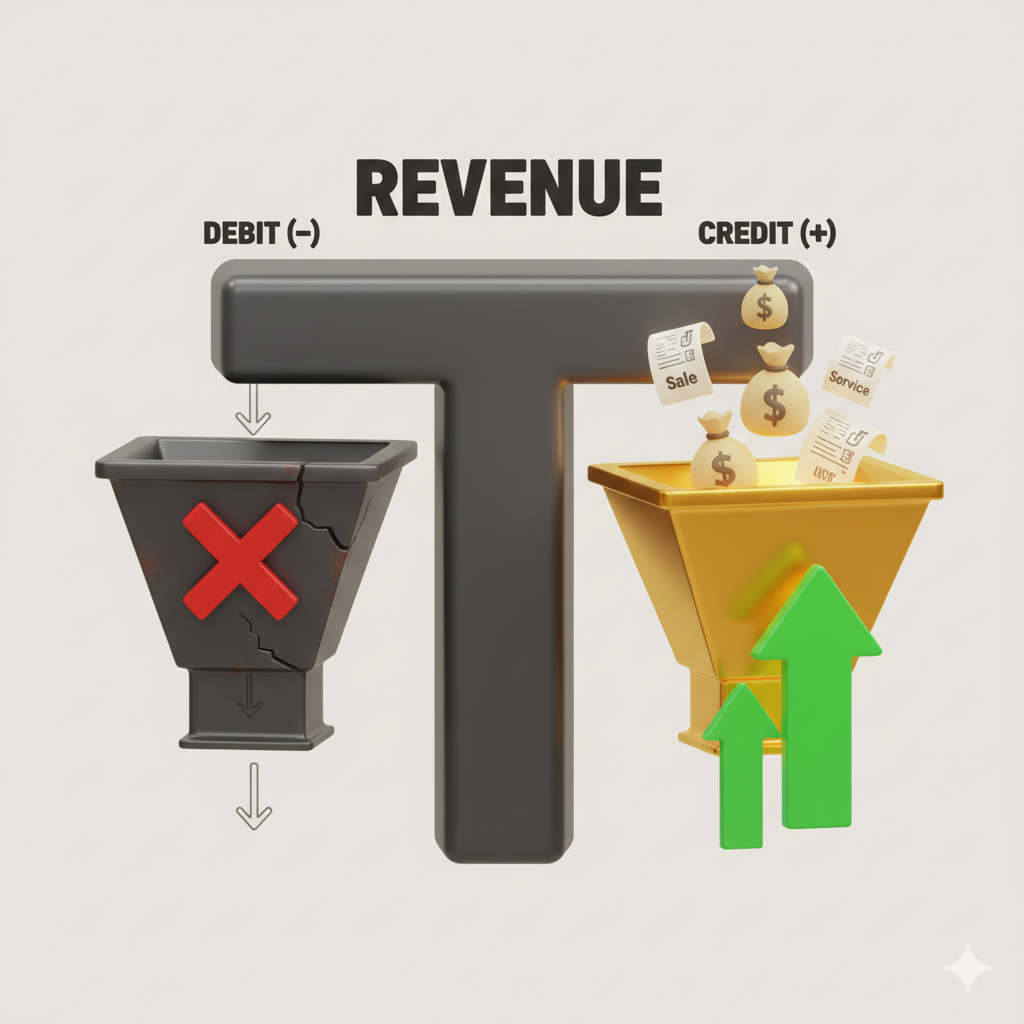
Mnemonic: Revenue behaves like Equity.
- Credit = more revenue
- Debit = less revenue
Example to memorize
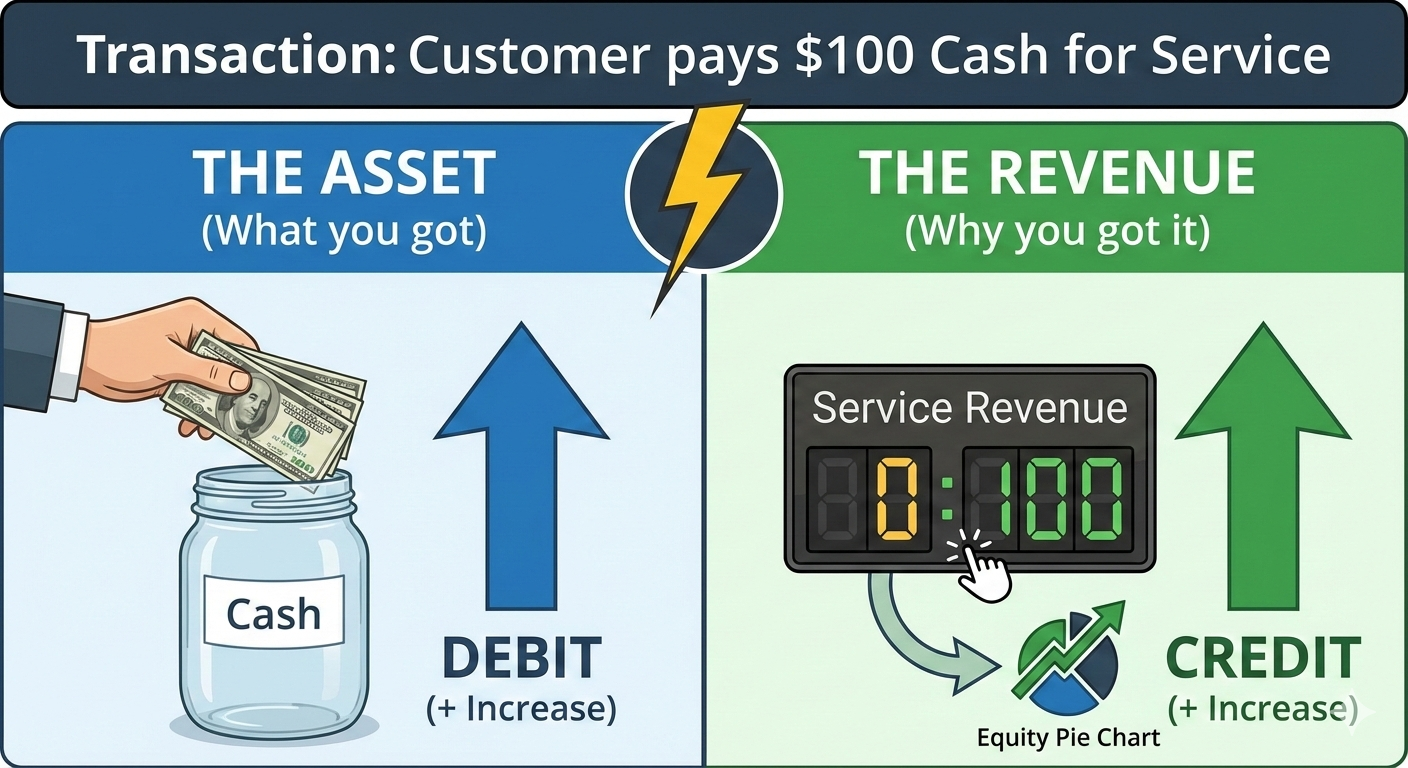
Customer pays cash for a service:
    Cash (ASSET)          Revenue
 ┌───────────────┐     ┌───────────────┐
 │ Debit  +100   │     │ Credit +100   │
 │               │     │               │
 └───────────────┘     └───────────────┘
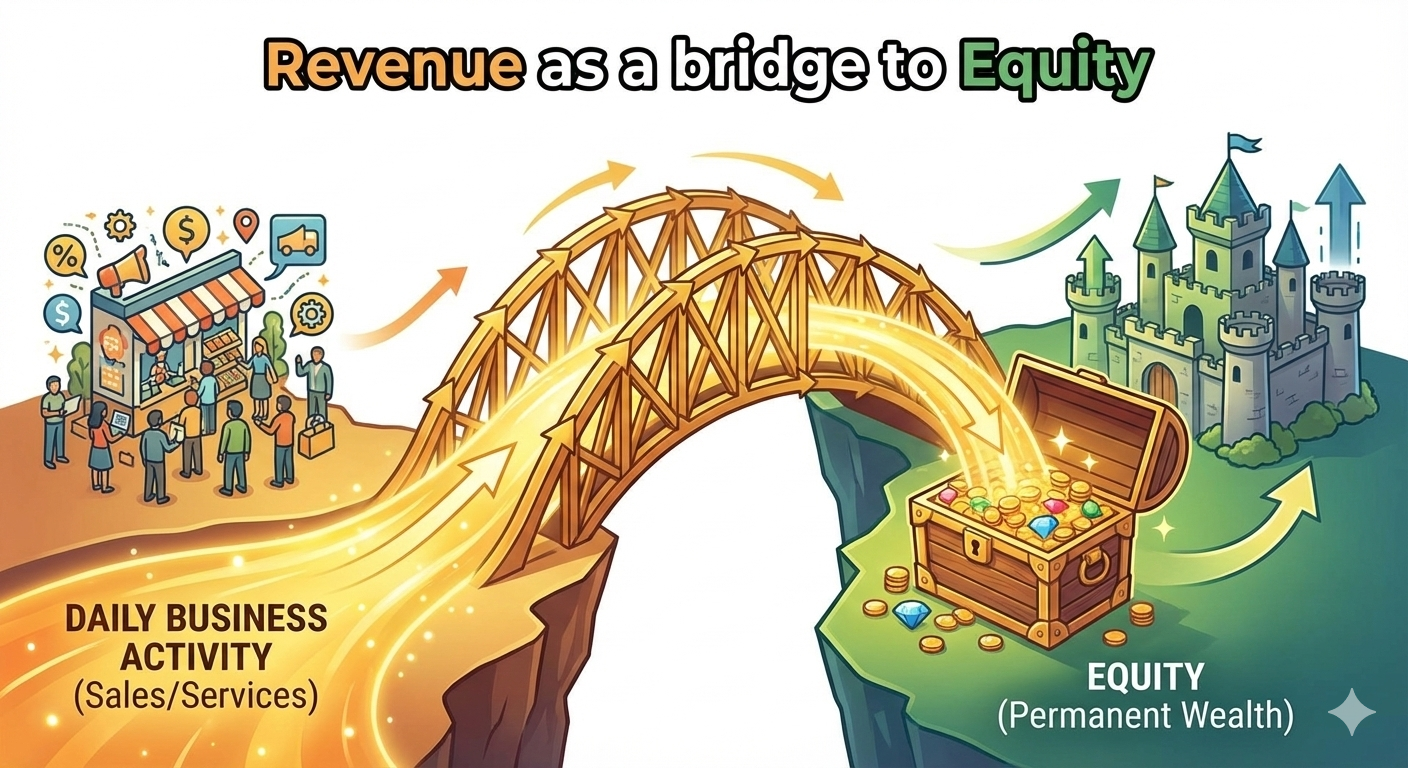
What's REALLY happening:
- Cash increases NOW
- Equity increases LATER
- Revenue is the bridge
Rule burned in:
REVENUE INCREASES ON THE CREDIT SIDE
REVENUE FLOWS INTO EQUITY AT CLOSING
Revenue is equity growing in slow motion.
🔥 Expenses → pull equity DOWN
Expense Account

Debit   ↑
Credit ↓Visual:
Pay rent →
Expense ↑ Debit
↓
Equity ↓
Cash (Asset) ↓ CreditExpense is equity bleeding out.
🧾 Dividends → equity leak
Dividends Account

Debit   ↑
Credit ↓Visual:
Pay owner →
Dividends ↑ Debit
↓
Equity ↓
Cash ↓ CreditNo business activity here — just ownership extraction.
5️⃣ Collapse everything into ONE picture
Think in vertical arrows:
           ↑ Credit
           |
Liab ──────┼────── Equity
           |
           ↓ Debit

Assets
↑ Debit
↓ Credit
Left side grows upward via Debit
Right side grows upward via Credit
6️⃣ Ultra-compact arrow cheat sheet
ASSETS:        Dr ↑   Cr ↓
LIABILITIES:   Dr ↓   Cr ↑
EQUITY:        Dr ↓   Cr ↑
REVENUE:       Dr ↓   Cr ↑
EXPENSES:      Dr ↑   Cr ↓
DIVIDENDS:     Dr ↑   Cr ↓
That's the entire system.
7️⃣ Why this will stick for you
This maps cleanly to:
- state vs mutations
- sources vs sinks
- left side = storage
- right side = claims
You're not learning accounting.
You're learning a constrained state machine.